
Executive summary
Memes are a form of cultural participation. They give a message a recognizable structure and invite the audience to complete its meaning. For an advertiser, that creates an opportunity: introduce a product through a situation the customer already understands. [13]
A 2026 Journal of Marketing paper brings that opportunity into measurable territory. Its six studies cover 900,139 social posts, 423,565 field-campaign impressions, and 3,958 controlled-experiment participants, reporting benefits across engagement, clicks, conversion, and purchase intent. [1]
Our position is that recognizable cultural patterns deserve a systematic place in creative strategy. The useful unit is a pattern that can be adapted to a customer problem, an offer, and a channel. Memes.ai applies this idea through brand context, creative generation, and iteration.
This whitepaper brings together 11 academic sources and 6 platform or product references. It is a selective research synthesis, not a systematic review or a new meta-analysis. Published findings, our interpretation, and proposed internal research are identified separately. No Memes.ai conversion uplift is claimed.
Three implications for an advertiser
- Start with a customer truth.Recognition works when the situation feels relevant.
- Give the brand a role.A reaction is useful when it connects to the offer.
- Test distinct ideas.Measure business outcomes alongside attention.
Make the cultural pattern a measurable input
Our thesis is that a cultural pattern can be specified, varied, and evaluated as part of an advertising system. The useful question moves from whether an ad looks like a meme to which recognizable situation connects this customer to this offer.
Separate five choices: the business context, the cultural pattern, the creative angle, the execution, and the outcome. A two-panel image is an execution. Expectation versus reality is a pattern. The hidden cost of a DIY repair is an angle. Keeping these choices distinct makes the next test more informative.
This decomposition is our application framework. It does not establish that one pattern will win or that we have already built a universal ranking of cultural formats. Its value is practical: a team can record what changed, compare alternatives, and accumulate evidence at the level of an idea.
The decisive test is whether adding explicit pattern context improves outcomes beyond a strong generic-AI baseline built from the same brief. Our proposed experiment below makes that comparison visible. A positive, null, or negative result would each teach us something useful.
One business. A sequence of testable choices.
Expectation versus reality
Choose the shared situation.What has actually been measured
Different studies answer different questions. A randomized exposure study can test a mechanism. A survey can identify associations. Platform data describes behavior in a specific environment. None automatically tells an advertiser what their next campaign will return.
The first figure reproduces a grocery retailer’s WeChat campaign. Both ads had RMB 5,000 budgets, but delivery was nonrandomized and audiences could overlap. The observed differences are useful evidence, with a narrower interpretation than a guaranteed causal lift. [1]
A second, independent study examined Instagram posts from 15 brands participating in the same viral trend. Meme posts received more likes and comments than subsequent non-meme posts, measured over 12 hours. Selection of already-viral examples and the lack of random assignment limit causal interpretation. [8]
From impression to purchase
Inspect the campaign data
| Measure | Conventional | Meme |
|---|---|---|
| impressions | 283,413 | 140,152 |
| clicks | 1,845 | 1,958 |
| orders | 106 | 162 |
| Click-through | 0.65% | 1.40% |
| Conversion | 5.75% | 8.27% |
| Return on ad spend | 1.14× | 1.52× |
Conversion is orders per click. ROAS is revenue divided by spend. These are the paper’s reported, rounded values. A separate experiment found no significant purchase-intent advantage under niche positioning.
Download figure dataEngagement across 15 brands
Mean likes per post
Mean comments per post
Read across the literature
11 of 11 academic sources · findings and their limits
Journal of Marketing · 2026
A multi-method research program reports improvements in engagement, click-through, conversion, and purchase intention under the tested conditions.
Interpretation boundary Effects depend on context; the field comparison does not establish a universal campaign uplift.
Psychology & Marketing · 2022
Experiments and brand-post analysis connect meme engagement with relevance, recognizable formats, humor, and distribution.
Interpretation boundary The 15-brand field comparison selected brands using one viral trend; it was not randomized.
Journal of Retailing and Consumer Services · 2024
Prominent brand placement outperformed subtle placement on ad attitudes and engagement in the tested settings, with narrative transportation as a mediator.
Interpretation boundary Brand knowledge, meme literacy, wording, and product context moderate the result.
Journal of Promotion Management · 2026
Relatedness and social connectedness help explain intentions to engage with branded memes.
Interpretation boundary A 479-consumer survey and qualitative study; engagement intention is not observed sales.
Journal of Interactive Marketing · 2026 (online 2025)
Reddit meme attention is temporary, with attention gains fading and saturation reducing the opportunity for further spread.
Interpretation boundary Platform-level observational evidence does not give every brand the same expiration date.
Roczniki Nauk Społecznych · 2026
More brand interference reduced perceived meme-likeness, which was positively associated with message effectiveness.
Interpretation boundary A nonrepresentative 264-person survey using one fictitious company.
Journal of the Academy of Marketing Science · 2009
Across 369 correlations, humor improves attention, positive affect, and ad attitudes, with weaker effects farther down the response chain.
Interpretation boundary The analysis also finds reduced source credibility. Humor and memes are overlapping, distinct categories.
Journal of Marketing Research · 2012
Emotionally activating content is more likely to spread; arousal helps explain sharing beyond positive versus negative sentiment.
Interpretation boundary News sharing and laboratory transmission are not a direct forecast of advertising returns.
Journal of Marketing Research · 2017
Emotional, brand-integral ads can combine greater sharing with stronger brand-related outcomes.
Interpretation boundary The brand must play a meaningful role in the story; sharing alone does not establish commercial value.
Journal of Computer-Mediated Communication · 2013
Memes can be understood as related cultural items sharing content, form, or stance, reproduced through participation and transformation.
Interpretation boundary A conceptual framework, not an effectiveness experiment.
Marketing Science · 2019
Observational ad-effect estimates often fail to reproduce results from randomized experiments, even with rich demographic and behavioral controls.
Interpretation boundary Used here to guide causal measurement; this research does not evaluate meme creative.
Recognition, participation, and relevance
Recognition supplies context before the brand has to explain itself. A familiar format can hold a contrast, a confession, or an expectation that fails. Shifman’s content–form–stance framework helps distinguish the structure of a meme from its particular image or wording. In practice, the format can stay recognizable while the business story changes. [13]
The 2026 lead paper identifies shared psychological ownership as a mechanism: viewers feel some ownership of the message and a stronger connection to the brand. The audience participates in the meaning rather than simply receiving a finished claim. [1]
Relatedness adds a social dimension. Kim and colleagues connect engagement intentions with social connection; Malodia and colleagues examine relevance, humor, familiarity, and distribution. These findings support a practical starting point: name a situation the intended audience can recognize in their own life. [2][8]
Emotion helps explain why a message travels. Berger and Milkman find that activating emotions are associated with sharing, while experiments support a role for arousal. This is adjacent evidence about transmission, not proof that emotional meme ads deliver incremental sales. An advertiser still has to connect the feeling to an offer. [11]
“I know this format.”
Recognition
“That’s so us.”
Participation
“This brand gets it.”
Connection
The conditions matter
Humor is not a complete explanation or an unconditional advantage. Eisend’s meta-analysis finds gains in attention and ad attitudes, alongside reduced source credibility and weaker effects on later outcomes. A joke can earn a reaction without improving belief in the advertiser. [10]
Brand visibility is a design problem, not a universal rule to hide the logo. Razzaq and colleagues find advantages for prominent brand placement, with effects depending on brand knowledge, meme literacy, and wording. Kiljańczyk and Kacprzak find that brand interference can reduce perceived meme-likeness. Different treatments, samples, and outcomes mean these are not interchangeable estimates. [9][4]
Our interpretation: make the brand necessary to the story without making the format hard to recognize. Akpinar and Berger’s work on valuable virality supports this distinction: emotional advertising can benefit the brand when the brand is integral to the content, rather than attached as an afterthought. [12]
Timing also changes the opportunity. Ward observes temporary meme-attention gains on Reddit and diminishing opportunity as a format saturates. The implication is to observe a format’s current audience and usage, rather than apply a fixed expiration date to every meme. [3]
A practical review should cover audience comprehension, tone, product relevance, and the intended action. Test the idea with people close to the customer. If they remember the joke but cannot explain what the business offers, the connection needs work.
Automation changes the advertiser’s work
Modern ad platforms increasingly choose the audience, auction, placement, and creative combination. Meta describes Andromeda as an ad-retrieval system within Advantage+ automation; its August 2026 GEM publication describes a recommendation foundation model trained on ad content and engagement signals. [5][15]
Google Performance Max combines automated delivery with advertiser-supplied assets and business inputs. Google also provides generative imagery and has announced 2026 creative diagnostics and asset-experiment capabilities. Advertisers should check which controls are available in their own accounts. [6][7][16]
The strategic inference is straightforward: the set of ideas entering the system matters. A collection of near-identical images offers fewer meaningful hypotheses than a set built around distinct customer tensions, benefits, and situations. This is our creative-strategy argument, not a platform claim that meme formats receive preferential ranking.
Creative is one controllable advantage, not the only one. Offer quality, margin, conversion tracking, landing-page performance, and customer experience still determine whether attention becomes profitable demand. Automated delivery cannot fix an irrelevant promise.
Distinct ideas.
Relevant brand context.
 Meta
Meta Facebook
 Instagram
 Google
Audience · Ranking · Placement · Asset combinations
A system for applying cultural patterns
Memes.ai starts from recognizable formats and connects them to a business. Its role is to help find useful structures, supply brand context, create alternatives, and refine executions. “Proven” describes a pattern’s cultural circulation; it does not certify a future return on ad spend.
A pattern is more than a reusable picture. Expectation versus reality, an uncomfortable tradeoff, or a relatable reaction can each generate different advertising hypotheses. Changing the customer problem or the reason to choose the product is a meaningful variation. Changing only a color or camera angle may be useful production work, but it tests a narrower idea.
The product’s documented workflow supports reusable brand context, generation, editing, and reframing, with assets that can be reused across creative formats. That makes the research actionable through a repeatable workflow. Product capabilities, however, remain separate from evidence of advertising effectiveness. [17]
The examples below are creative illustrations. They show how the same business problem can be expressed through a recognizable structure. They are not study stimuli, customer testimonials, or measured campaign winners.
How the idea becomes a workflow
Ground the brief
The website supplies business context. A campaign goal can add the intended outcome and constraints.
Separate the hypotheses
The live preview requests four directions: product truth, human tension, desired state, and pattern break. Each changes the premise of the creative.
Review and iterate
Studio workflows support brand context, reference assets, generation, editing, and reframing. Human review connects the output to the offer.
The four-direction preview is available on this page; reusable brand and editing workflows are documented in the API reference. [17]
A performance benchmark that ranks pattern families by incremental business impact remains a research objective.
- 01Cultural context
Find a pattern
Identify the familiar structure and the audience that recognizes it.
- 02Business context
Ground it in the brand
Connect the customer situation to the product, voice, and offer.
- 03Creative production
Create distinct angles
Explore different problems, benefits, and reasons to act.
- 04Measured feedback
Test and refine
Use campaign evidence to keep, change, or retire the idea.
Same principle. Different businesses.
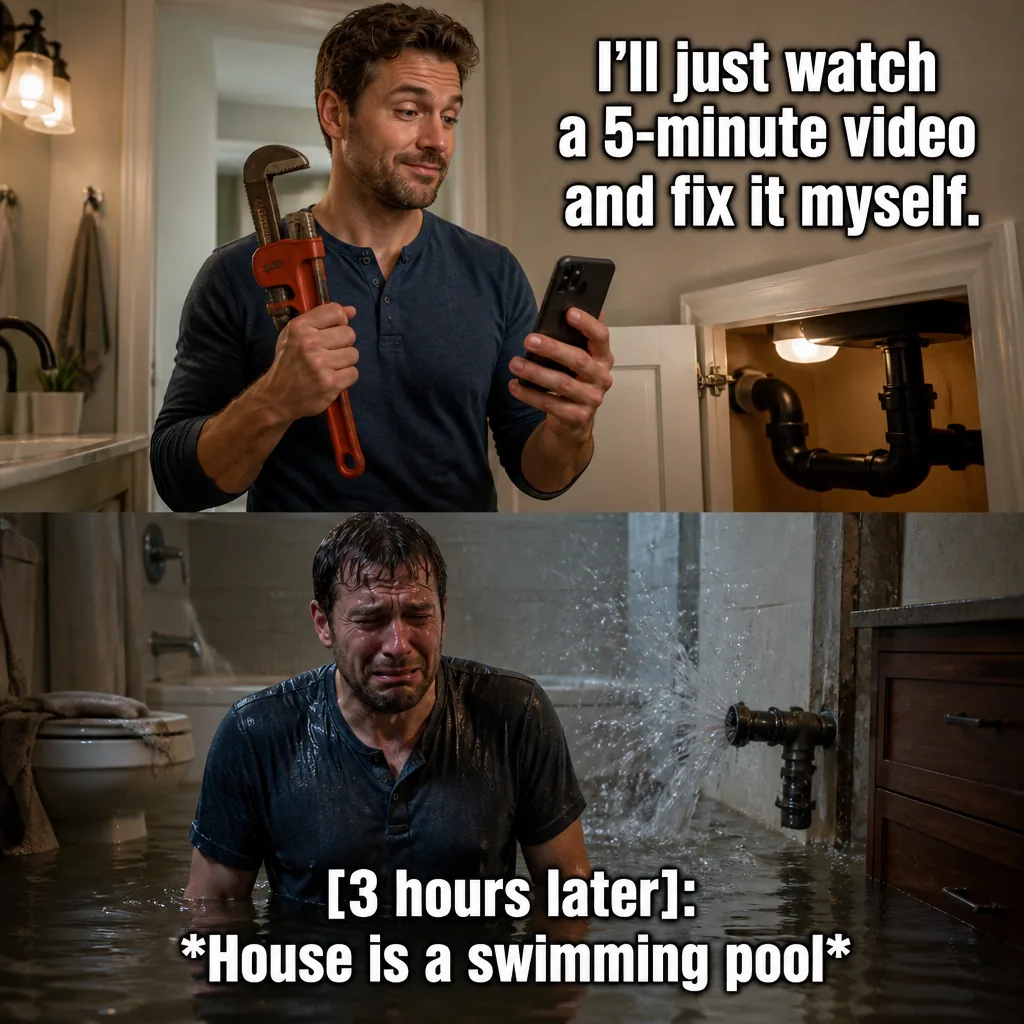
Expectation vs. reality
Turn a familiar customer mistake into a reason to call a professional.
Some jobs deserve a professional.
Book your local plumberA practical experimental protocol
Measurement should begin with the decision, before the creative is produced. Does the advertiser want more qualified purchases, more leads that become customers, or lower acquisition cost? Select a primary outcome that answers that decision and treat engagement metrics as supporting diagnostics.
Comparing the platform’s favorite meme ad with a lightly delivered conventional ad is not a clean experiment. Delivery systems actively select exposure. Gordon and colleagues show that observational estimates often fail to reproduce randomized results even with detailed controls. Use randomized creative experiments where feasible and state the unit of randomization. [14]
A useful creative comparison holds the offer, destination, objective, attribution window, and eligibility rules constant. Test several distinct concepts in each creative family so a single weak control or unusually good meme does not define the entire comparison. Report which factors could not be held constant.
Specify the minimum effect worth detecting, sample-size assumptions, analysis window, and stopping rule before launch. Early results are noisy, and repeated peeking creates opportunities to declare a winner by chance. Report uncertainty, failures, exclusions, and the full set of tested variants alongside the best result.
A creative test estimates the difference between creative strategies under its assignment rules. A no-ad holdout asks a different question: the incremental effect of advertising itself. Neither a before/after chart nor a platform-attributed conversion count should silently stand in for that distinction.
| Metric & calculation | What it tells you |
|---|---|
Click-through rateClicks ÷ impressions | How often a served ad produces a click.Impressions are exposures, not unique people. |
Post-click conversionConversions ÷ clicks | How often a click is followed by the specified action.Define the event and attribution window. |
Cost per acquisitionAd spend ÷ acquisitions | The media cost of a defined acquisition.A cheap lead is not necessarily a customer. |
Return on ad spendAttributed revenue ÷ ad spend | Revenue assigned to the campaign per unit of spend.Does not equal profit or incremental revenue. |
Incremental liftTreatment outcome − control outcome | The estimated effect under the experiment’s assignment.Specify absolute versus relative lift and uncertainty. |
Our own evidence: the next layer
Publication status: proposed protocol; internal dataset pending validation. This section intentionally contains no performance estimates. The table defines the evidence needed for a future Memes.ai benchmark and keeps missing values visibly separate from measured results.
The central question is whether a repeatable, brand-grounded pattern workflow improves business outcomes relative to an appropriate creative baseline. A second question is operational: whether it reduces the time and cost required to produce a useful set of distinct concepts. Those questions require different datasets and should be reported separately.
A defensible campaign dataset would connect a creative’s origin and pattern family to platform delivery, spend, attributed events, and verified business outcomes. It would preserve brand, market, placement, date, and experimental assignment. Generation counts alone would measure production activity, not market impact.
We would report both brand-level results and appropriately weighted aggregates. A small number of high-spend advertisers should not silently define the experience of every business. Findings should be segmented by industry and objective only where the sample supports that analysis, with uncertainty and missingness disclosed.
The proposed release would include a documented cohort, observation window, metric dictionary, exclusions, analysis code or reproducible calculations, and limitations. Customer-identifying records would not be part of the public benchmark. Until those requirements are met, the appropriate value for an internal uplift estimate is “not yet established.”
Does the pattern add value?
Conventional creative
A professional product-led brief.
Generic AI creative
The same brief, without supplied cultural patterns.
Pattern-informed creative
The same brief, with an explicit pattern and brand connection.
Primary comparison: C versus B. Same business brief. Explicit cultural-pattern input is the variable of interest.
Primary comparison
C versus B tests the added value of explicitly supplying a cultural pattern. C versus A is a secondary comparison of creative strategies.
Assignment
Use a randomized platform experiment when supported; keep eligible audiences mutually exclusive. Document the platform’s delivery and optimization rules.
Primary outcome
Preselect a verified business conversion and report its rate using the declared assignment denominator. Include acquisition cost as an operational outcome.
Production controls
Match the brief, offer, destination, number of candidate concepts, review rubric, and production allowance. Record model versions, edits, and unavoidable differences.
Analysis
Fix the sample-size calculation, minimum meaningful effect, stopping rule, and attribution window before launch. Publish uncertainty and all tested variants.
Publication status
Protocol proposed. Brands, budget, sample size, dates, and experimental assignment are not yet committed. No performance results are available.
Creative production time
Minutes to a reviewable set
Required: Timestamped briefs, completed outputs, and human review.
Concept diversity
Distinct ideas per brief
Required: A defined rubric and independent concept labels.
Qualified acquisition cost
Spend per verified acquisition
Required: Campaign exports, outcome joins, and a comparison group.
Incremental business effect
Lift with an uncertainty interval
Required: Randomized assignment, event definitions, and a fixed analysis plan.
Creative fatigue
Performance by exposure and time
Required: Longitudinal delivery, frequency, and outcome data.
No measured values are available in this publication. “Pending” means not yet established.
The operating implications
For a business owner, the first step is small: choose one customer problem, one relevant offer, and a few genuinely different ways to express them. Use a familiar cultural pattern where it helps the customer recognize the situation. Keep the reason to act visible.
For a creative team, maintain a library of patterns together with audience context and usage notes. Distinguish a format from its current cultural moment. Keep a record of what was tested, what the result measured, and whether the finding was repeated. A reusable learning is more valuable than a screenshot of a winning metric.
For the industry, the opportunity is a better connection between cultural understanding, creative production, and causal measurement. The research is sufficient to justify deliberate experimentation. It is not sufficient to promise the same uplift to every advertiser. Memes.ai’s approach is to make the experimentation practical.