

Ad creative
Ad Creative Testing: A Practical Plan for Your Next Campaign
By Memes.ai
Updated October 16, 2026 · 5 min read
Creative testing is a way to learn which message or execution better supports a defined objective. It is not a contest to collect the most likes. Start with a question, keep the comparison interpretable, and decide what evidence would justify the next action.
What you’ll take away
- Separate broad concept exploration from controlled comparisons.
- Choose the objective and decision rule before launch.
- Treat small or uneven samples as uncertain.
1. Write a question you can answer
The idea — For example: ‘Does a commute use case or a weekend use case bring more qualified product visits?’
Why it helps — A specific question determines what the variants need to change.
Make it your own — Avoid ‘Which ad is best?’ without an audience, objective, and conversion definition.
2. Choose the level of the test
The idea — Explore substantially different concepts first, then refine a promising concept with narrower changes.
Why it helps — Changing the scene, headline, and format together can identify a useful package but cannot isolate the cause.
Make it your own — Label concept exploration honestly. For a controlled comparison, change one meaningful variable and hold the rest steady.
3. Set the outcome before you see results
The idea — Choose the business action and supporting diagnostic metrics.
Why it helps — An eye-catching ad can win clicks while attracting people who do not want the product.
Make it your own — Track the relevant downstream action. Confirm the destination and measurement work before spending.
4. Keep the comparison fair
The idea — Use comparable audiences, timing, destinations, and offers, or the platform’s appropriate experiment setup.
Why it helps — Different delivery conditions can explain a difference that appears to come from creative.
Make it your own — Document the setup and any delivery imbalance. Do not read raw conversion totals as a clean comparison when exposure differs.
5. Plan enough evidence
The idea — Estimate the traffic and conversions needed for a useful decision based on your baseline and the difference you care about.
Why it helps — A few early outcomes can move rates dramatically.
Make it your own — Set a review window and avoid repeatedly declaring a winner after every small fluctuation. Use experiment uncertainty where available.
6. Read the whole path
The idea — Compare attention, relevant visits, and the final business action.
Why it helps — A mismatch after the click may indicate a promise or landing-page problem.
Make it your own — Inspect whether the winning hook leads to the expected product. Keep creative and destination diagnosis connected.
7. Record what the result actually supports
The idea — Write the observation, the limits, and the next hypothesis.
Why it helps — A result from one audience and period does not establish a universal creative rule.
Make it your own — Say ‘commute concept performed better in this test’ rather than ‘office imagery always converts.’
8. Build the next test from the lesson
The idea — Keep a useful concept and change a meaningful execution detail.
Why it helps — A sequence of connected tests is easier to learn from than random new variants.
Make it your own — If the commute scene looks promising, compare two clear headlines while preserving the product, audience, and destination.
Put it into practice
A three-concept starting plan
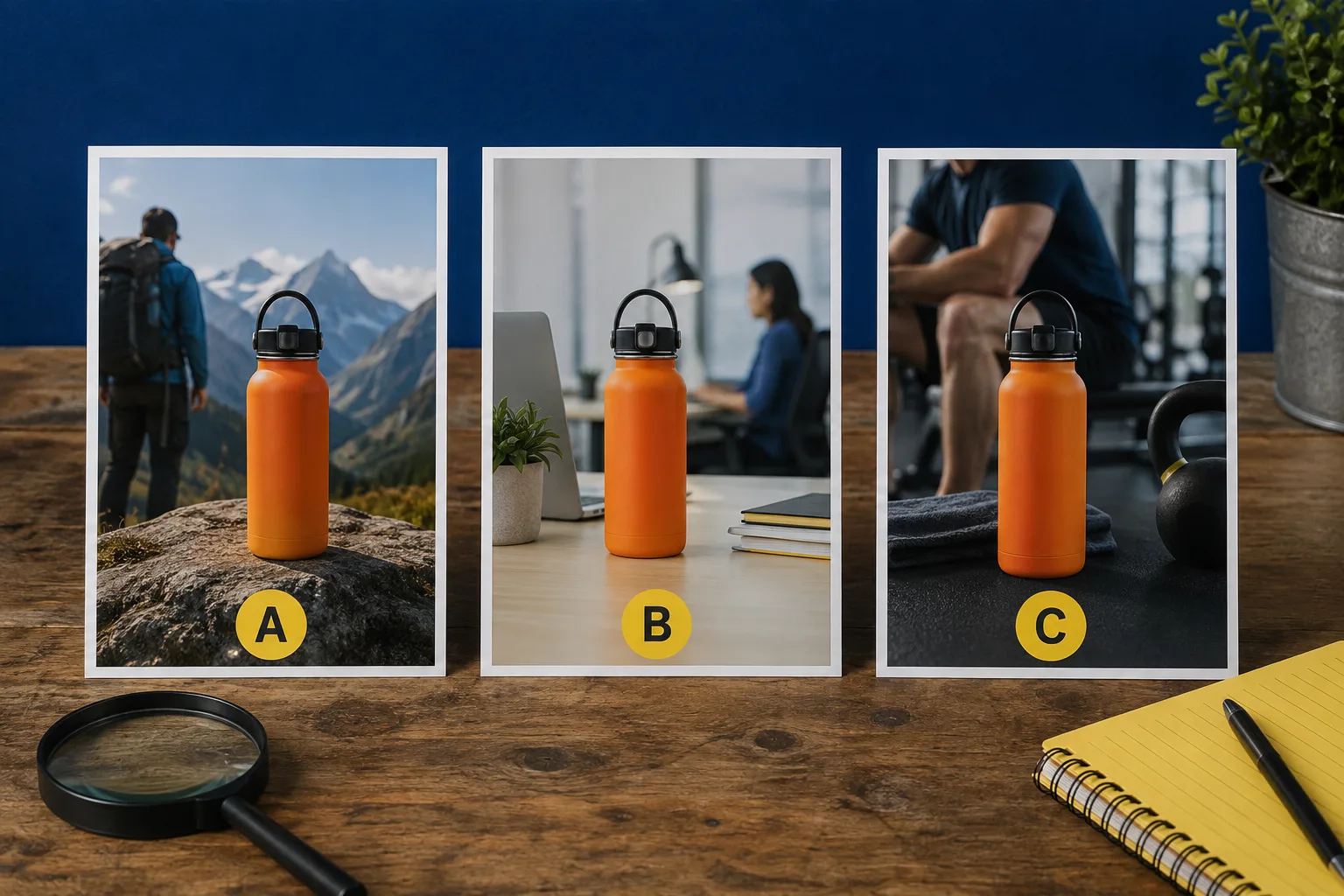
For a bottle, compare hiking, desk, and gym concepts as an exploratory round. Keep the same verified product claims and destination. Record delivery and downstream actions for each. If the desk concept earns a useful signal, test two desk headlines next. Do not claim the background caused the first result when several creative elements changed together.
Put it into practice
Compare two art directions without confusing execution with a concept
Keep the level of the comparison explicit. In this original fictional plan, a desk-folder concept answers “Where can I keep the next note?” One execution uses warm cream light; another uses a cooler blue-gray setting. The product, approved headline, audience question and destination stay the same. That is a mood/execution comparison, not evidence that two different customer needs have been tested.
For concept exploration, write different reasons to consider the same verified service. An invented design service could explain a clearer initial brief, a specific review handoff, a supported final format or a useful destination. These are proposed angles only. Each needs actual service facts, a distinct audience question and one matching next step before production. Do not imply that the service includes every angle just because a writer can name it.
Record which variables changed and what the comparison can support. If both the headline and scene change, call the round exploratory rather than attributing a result to light temperature. Choose a business outcome and a review plan before delivery. A local design preference, colleague reaction or generated image is not an advertising result. Keep the next revision tied to what the actual evidence supports.
Common questions
How many ads should I test at once?
Use a number your available traffic and budget can meaningfully support. More variants divide the evidence. A smaller focused comparison is often easier to interpret.
When should I stop a test?
Use the preplanned review criteria and the experiment’s uncertainty. A safety issue or broken destination warrants intervention, but a few early conversions do not establish a reliable winner.
Is warm versus cool a new concept test?
Usually it is an execution change when the message, audience task and offer stay fixed. Describe the level honestly and record every changed variable.
Can I call the more attractive version a winner?
You can record a review preference. A business-result claim needs actual comparable delivery and outcome evidence, with its limits.
Turn the brief into your own creative
Turn a focused brief into an original concept using your own product facts, then review the message and destination before testing.
Your starter brief
Replace the brackets with your own details.
Build a creative test plan for [product] with objective [action]. Baseline information: [data or unknown]. Propose three distinct concepts, the hypothesis for each, constants, primary metric, diagnostic metrics, and a decision process that acknowledges insufficient data. Do not invent sample-size certainty.