
Meme marketing
8 Meme Formats for Business, With Original Image Examples
By Memes.ai
Updated October 6, 2026 · 4 min read

A useful social post starts with a specific situation your reader recognizes. This guide gives you 8 worked examples and practical steps, plus image references and instructions for making each one your own. Start with “intention versus reality,” then choose a second idea that serves a different purpose. Use the reference image for inspiration, or copy its brief into Studio to create a version with your business details.
What you’ll take away
- Choose one useful information post, one everyday moment, and one introduction from the examples.
- Pair the caption with the actual subject it describes, using an authorized photograph or an explicitly illustrative creative.
- Change one idea at a time and use actual replies, visits, or enquiries to decide which direction to develop.
1. Intention versus reality
Visual reference: The Feature Creep Loop. The caption and brief below are an adaptation; replace any business details with your own.
Worked example — Setup: I will choose one pastry. Payoff: The counter became the shortlist.
Why it helps — The contrast lets the reader understand the change at a glance. It suits an ordinary decision rather than a dramatic result claim.
Make it your own — Use two original scenes or two clear text panels. Keep both versions about the same customer moment.
Image brief to adapt
Create an original illustrative social image for your business. Concept: Intention versus reality. Visual direction: The contrast lets the reader understand the change at a glance. It suits an ordinary decision rather than a dramatic result claim.. Adaptation: Use two original scenes or two clear text panels. Keep both versions about the same customer moment. Use fictional scenes unless I supply authorized photographs. Keep all product, service, and business details exactly as supplied. Use [brand colors] and leave room for [business name]. Return one version with clear, short text.
2. A small task, a giant prop

Visual reference: The Dev Debt Dilemma. The caption and brief below are an adaptation; replace any business details with your own.
Worked example — Setup: One quick visit. Payoff: One very prepared tool bag.
Why it helps — The oversized object supplies the visual payoff, so little text is required.
Make it your own — Exaggerate the prop rather than a person's body. Keep the service context recognizable.
Image brief to adapt
Create an original illustrative social image for your business. Concept: A small task, a giant prop. Visual direction: The oversized object supplies the visual payoff, so little text is required.. Adaptation: Exaggerate the prop rather than a person's body. Keep the service context recognizable. Use fictional scenes unless I supply authorized photographs. Keep all product, service, and business details exactly as supplied. Use [brand colors] and leave room for [business name]. Return one version with clear, short text.
3. The object's inner monologue

Visual reference: The Churn Monster. The caption and brief below are an adaptation; replace any business details with your own.
Worked example — Setup: The calendar saw the plan. Payoff: The calendar requested edits.
Why it helps — Giving an ordinary work object a voice makes an abstract planning problem concrete.
Make it your own — Choose a calendar, notebook, box, or bag your audience actually uses.
Image brief to adapt
Create an original illustrative social image for your business. Concept: The object's inner monologue. Visual direction: Giving an ordinary work object a voice makes an abstract planning problem concrete.. Adaptation: Choose a calendar, notebook, box, or bag your audience actually uses. Use fictional scenes unless I supply authorized photographs. Keep all product, service, and business details exactly as supplied. Use [brand colors] and leave room for [business name]. Return one version with clear, short text.
4. The escalating list

Visual reference: The Spreadsheet Nightmare. The caption and brief below are an adaptation; replace any business details with your own.
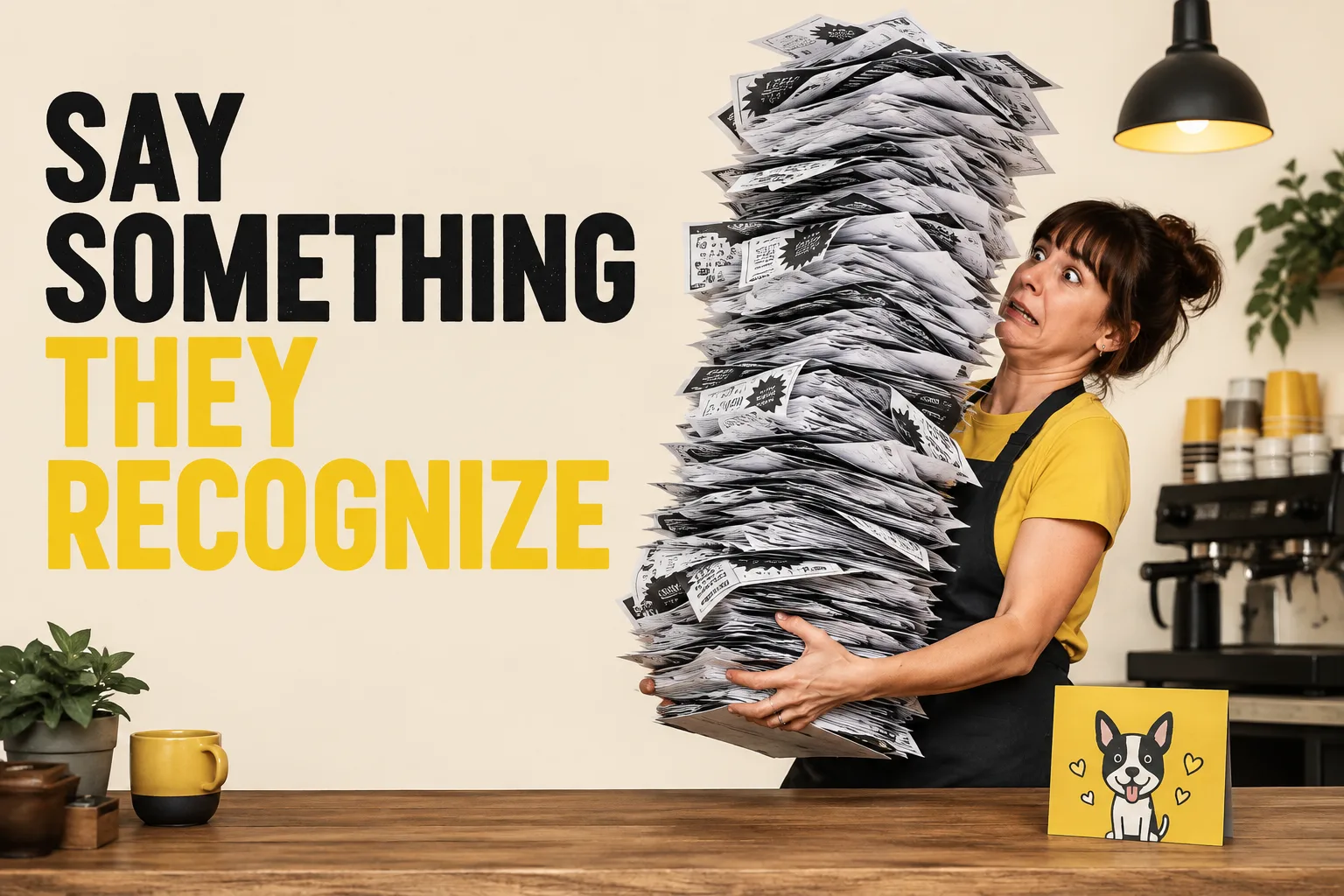
Worked example — Setup: One quick question. Payoff: The questions formed a committee.
Why it helps — A growing stack turns the escalation into something the reader can see.
Make it your own — Use fictional notes with no private client or account details.
Image brief to adapt
Create an original illustrative social image for your business. Concept: The escalating list. Visual direction: A growing stack turns the escalation into something the reader can see.. Adaptation: Use fictional notes with no private client or account details. Use fictional scenes unless I supply authorized photographs. Keep all product, service, and business details exactly as supplied. Use [brand colors] and leave room for [business name]. Return one version with clear, short text.
5. The product-adjacent decision

Visual reference: The Seamless Integration. The caption and brief below are an adaptation; replace any business details with your own.
Worked example — Setup: I only came in for coffee. Payoff: The pastries had other ideas.
Why it helps — The product belongs to the moment without requiring a fabricated benefit or review.
Make it your own — Use accurate actual product imagery when promoting a named item.
Image brief to adapt
Create an original illustrative social image for your business. Concept: The product-adjacent decision. Visual direction: The product belongs to the moment without requiring a fabricated benefit or review.. Adaptation: Use accurate actual product imagery when promoting a named item. Use fictional scenes unless I supply authorized photographs. Keep all product, service, and business details exactly as supplied. Use [brand colors] and leave room for [business name]. Return one version with clear, short text.
6. The ordinary routine

Illustrative creative reference. Use the specific image brief below to create a version for this example.
Worked example — Setup: Packed the bag. Payoff: Checked the bag. Checked it again.
Why it helps — A shared habit makes the premise specific to a role or activity.
Make it your own — Name the actual task and keep the tone welcoming to beginners.
Image brief to adapt
Create an original illustrative social image for your business. Concept: The ordinary routine. Visual direction: A shared habit makes the premise specific to a role or activity.. Adaptation: Name the actual task and keep the tone welcoming to beginners. Use fictional scenes unless I supply authorized photographs. Keep all product, service, and business details exactly as supplied. Use [brand colors] and leave room for [business name]. Return one version with clear, short text.
7. The unexpected owner
Worked example — Setup: Bought the perfect toy. Payoff: The box received five stars.
Why it helps — The viewer can see who supplies the payoff, making the joke clear without famous characters.
Make it your own — Keep the rating an obvious fictional joke, not a customer testimonial.
Image brief to adapt
Create an original illustrative social image for your business. Concept: The unexpected owner. Visual direction: The viewer can see who supplies the payoff, making the joke clear without famous characters.. Adaptation: Keep the rating an obvious fictional joke, not a customer testimonial. Use fictional scenes unless I supply authorized photographs. Keep all product, service, and business details exactly as supplied. Use [brand colors] and leave room for [business name]. Return one version with clear, short text.
8. The quietly confident response
Worked example — Setup: The checklist is complete. Payoff: Enjoying this extremely specific feeling.
Why it helps — An understated reaction can suit a professional brand that avoids loud promotional humor.
Make it your own — Make the completed task administrative; do not imply a customer outcome the image cannot prove.
Image brief to adapt
Create an original illustrative social image for your business. Concept: The quietly confident response. Visual direction: An understated reaction can suit a professional brand that avoids loud promotional humor.. Adaptation: Make the completed task administrative; do not imply a customer outcome the image cannot prove. Use fictional scenes unless I supply authorized photographs. Keep all product, service, and business details exactly as supplied. Use [brand colors] and leave room for [business name]. Return one version with clear, short text.
Put it into practice
Build a useful first batch
Start with “Intention versus reality” and “A small task, a giant prop.” Give each post a different role: one can introduce a person or process, another can answer a reader question, and another can invite a simple response. Keep a note of the caption, image, destination, and publishing date. Review actual questions and responses together. Revise the next batch around what people understood or asked about, rather than treating one example as a promised result.
Common questions
Can I use these examples as written?
Treat the copy as a starting point. In “Intention versus reality,” keep the central situation, replace any bracketed details with your actual information, and choose a next step that your business can fulfill. Read the caption alongside the image so the two tell the same story.
Which image should I pair with “A small task, a giant prop”?
Use the visual direction and adaptation note beside that example. The displayed image is an illustrative reference. For a post about an actual person, product, location, or completed job, use an authorized real photograph or clearly label a conceptual illustration.
How should I choose the first few examples?
Start with “Intention versus reality” and a contrasting idea such as “The quietly confident response.” Choose examples that answer real reader questions or show something specific about your work. Keep the first batch small enough to revise after reviewing actual responses.
Can I customize these images in Studio?
Save a reference image or copy the image brief, then create your own version in Studio with your business details and visual direction. A downloaded WebP is a finished image; the brief gives you a way to develop a new variation. Review generated text and factual details before publishing.
Turn the brief into your own creative
Use these concepts to build a creative for your actual business. Browse the related example collection for more visual directions, then bring your caption and image brief into Studio.
Your starter brief
Replace the brackets with your own details.
Create an original illustrative social image for your business. Concept: Intention versus reality. Visual direction: The contrast lets the reader understand the change at a glance. It suits an ordinary decision rather than a dramatic result claim.. Adaptation: Use two original scenes or two clear text panels. Keep both versions about the same customer moment. Use fictional scenes unless I supply authorized photographs. Keep all product, service, and business details exactly as supplied. Use [brand colors] and leave room for [business name]. Return one version with clear, short text.