
Meme marketing
AI Meme Generator Prompts: 8 Briefs You Can Adapt
By Memes.ai
Updated September 6, 2026 · 6 min read
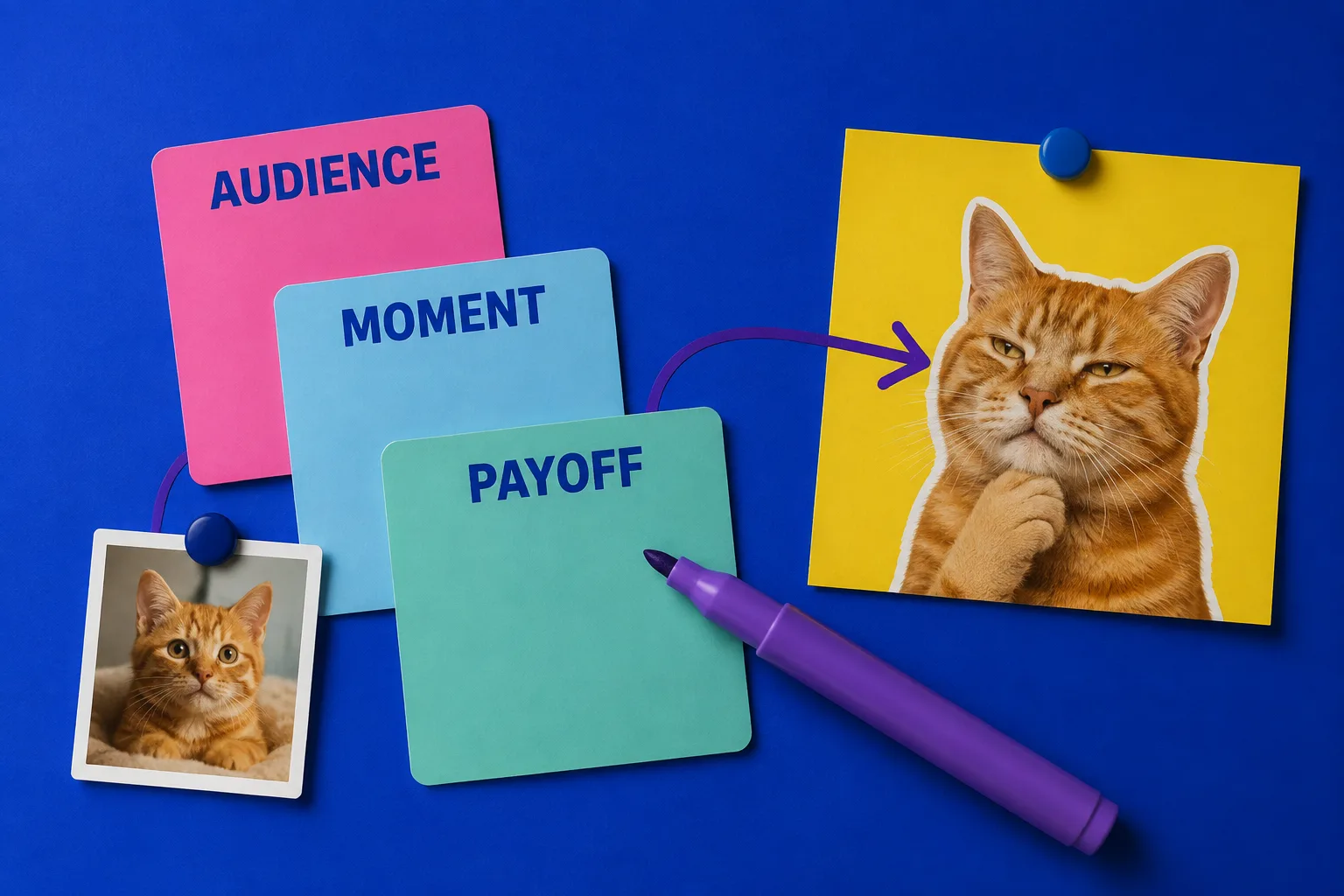
A useful AI meme prompt describes the audience, the moment, and the payoff. Make a funny ad leaves all three to guesswork. A brief about a cafe customer's first meeting before coffee gives the generator something concrete to build. These eight prompt structures cover different kinds of contrast. Replace the placeholders with true details from your business, then review the result as an editor rather than treating the first image as finished.
What you’ll take away
- Name a moment instead of asking for generic humor.
- Specify the image and exact caption separately.
- Generate options, then select and revise deliberately.
1. The intention-versus-reality brief
The idea — Use: Show [audience] planning [ideal behavior], contrasted with [what usually happens]. For a meal-prep service, the setup could be an ambitious Sunday planner and the payoff a chaotic Tuesday lunch.
Why it helps — The two states give the model a clear structure. You can change the visual style without losing the underlying joke, which makes revisions easier to judge.
Make it your own — Specify which panel comes first and keep each caption short. Avoid implying that the product guarantees a personal transformation; show a practical use case instead.
2. The tiny problem, enormous reaction brief
The idea — Use: Show an exaggerated but friendly reaction to [small shared inconvenience]. A creator discovering one more required image crop could be surrounded by an absurd pile of picture frames.
Why it helps — Scale provides the joke visually. The caption can stay compact because the oversized reaction already communicates the feeling.
Make it your own — Tell the model to exaggerate the props rather than distort the person's body. Keep the expression readable and remove background objects that do not strengthen the contrast.
3. The customer inner-monologue brief
The idea — Use: Show [ordinary moment] with the exact thought [short line]. A bakery customer staring at a pastry case might think I only came in for coffee.
Why it helps — Internal thoughts can feel conversational because they mirror a small contradiction people admit about themselves. The business belongs naturally in the scene.
Make it your own — Give the character one action and one thought. Do not ask for a full conversation, testimonial, and offer in the same image.
4. The product-as-payoff brief
The idea — Use: Establish [frustration], then reveal [specific verified product feature] as the practical resolution. A backpack concept can show the objects that fit rather than claiming it holds everything.
Why it helps — The visual explains the product while the setup makes it relatable. This is useful when the buyer needs to understand a feature before considering an offer.
Make it your own — List exactly which product details must remain accurate. If using a reference photo, preserve shape, packaging, and visible labels; do not invent certifications or capacities.
5. The two-types-of-customer brief
The idea — Use: Show two affectionate habits within [audience], each with a short label. A coffee example could contrast the person who plans an order with the person who changes it at the counter.
Why it helps — The comparison invites recognition without requiring a winner or a villain. It can work as a single split image or a short carousel.
Make it your own — Keep both sides friendly. Avoid dividing people by sensitive traits or presenting one customer type as stupid, unattractive, or undesirable.
6. The workplace-specific brief
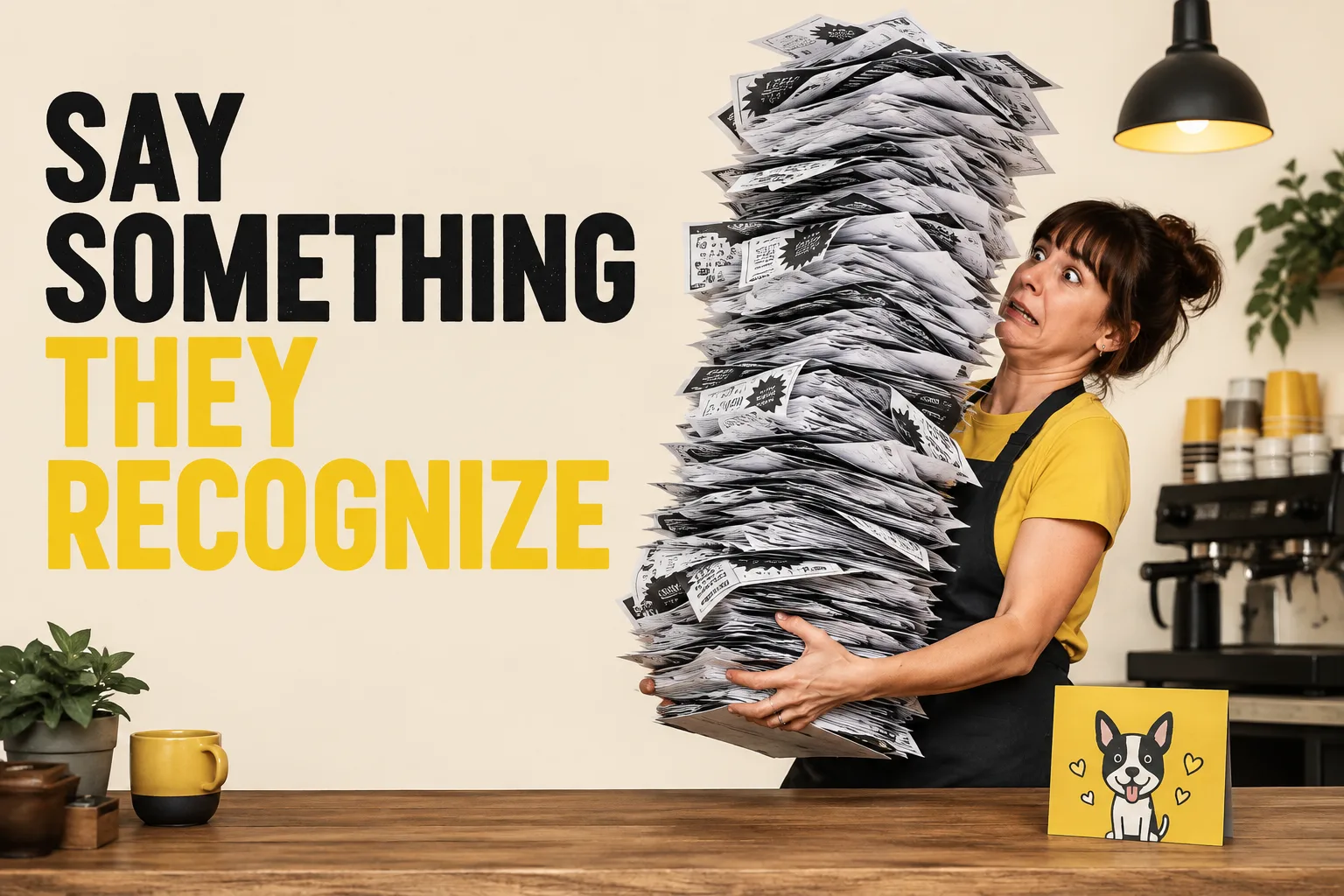
The idea — Use: Show the moment when [role] encounters [specific workflow friction]. A marketing team approving a simple caption through an enormous stack of notes is more concrete than a joke about meetings.
Why it helps — Job-specific details create relevance for a narrower audience. They also help keep B2B creative from sounding like a consumer meme with a software logo added.
Make it your own — Name the task and the consequence. Remove real customer names, screenshots, or confidential documents from the visual brief.
7. The seasonal decision brief
The idea — Use: Show [audience] deciding between [two timely choices] during [real occasion]. A gift guide can contrast useful gifts with another object that will sit unopened.
Why it helps — An actual decision makes the occasion relevant. The date alone is not a joke, and a seasonal color palette does not explain why the customer should care.
Make it your own — Include only genuine offer dates and conditions. Ask for placeholders where information is missing instead of allowing the generator to invent a discount or countdown.
8. The rewrite-and-critique brief
The idea — Use: Review this meme for clarity, relevance, and unnecessary words. Give three shorter captions that preserve [specific premise]. Explain what changes in each.
Why it helps — Editing is often more useful than requesting a completely new image. It keeps the strong part of the concept while addressing an identifiable problem.
Make it your own — Ask for one change at a time: caption, expression, product visibility, or composition. Keep a version history so you can compare the revision with the original.
Put it into practice
Run the substitution test
Take your strongest prompt and replace the business with an unrelated category. If the proposed image barely changes, the brief needs more specificity. Add a real product detail, a customer phrase, or an environment that only makes sense for the original use case. Then generate two visual directions from that same improved brief. This tests execution while preserving a clear creative idea.
Common questions
Should I put the caption in the image prompt?
If you want text rendered in the image, specify the exact wording. For precise typography or frequent revisions, you can generate the visual first and add or edit the caption separately.
Why do AI memes sometimes feel generic?
The brief may describe a broad audience without a recognizable moment. Add a specific task, objection, or habit, and make the product connection explicit.
How many ideas should I generate at once?
Start with a small set you can actually review. Three distinct premises are usually more informative than many near-identical versions of one vague idea.
Turn the brief into your own creative
Paste a completed brief into your creative workflow and use your website or product reference to keep the output tied to your business.
Your starter brief
Replace the brackets with your own details.
Audience: [who]. Recognizable moment: [specific situation]. Product truth: [verified feature]. Meme structure: [contrast/reaction/inner monologue]. Exact setup: [text]. Exact payoff: [text]. Visual: [subject, action, setting]. Tone: [tone]. Create an original image with readable captions. Do not invent offers, testimonials, performance numbers, logos, or product features. Return one concept first.