
Social media
6 Product Launch Social Media Ideas From Teaser to Follow-Up
By Memes.ai
Updated September 6, 2026 · 4 min read

A launch is a sequence of useful explanations, not one announcement repeated in different colors. Help people understand the problem, see the product, judge the details, and find the next step. This six-part plan keeps the story connected from the first preview through the questions that follow.
What you’ll take away
- Give every launch post a distinct job.
- Move from context to evidence to action.
- Prepare answers and follow-up content before launch day.
1. Introduce the problem
The idea — Show the situation that led to the product, such as an awkwardly lit reading corner.
Why it helps — The audience gets a reason to care before seeing a reveal.
Make it your own — Use a real customer need or clearly fictional scenario. Avoid inventing research findings.
2. Reveal the product clearly
The idea — Show the complete item with its name and the simplest useful description.
Why it helps — A viewer should be able to identify what launched without solving a visual puzzle.
Make it your own — Use an accurate product image. Include the launch date or availability status in ordinary language.
3. Demonstrate one meaningful feature
The idea — Show the lamp adjustment, bag opening, or setup process.
Why it helps — The launch claim becomes more concrete when the action is visible.
Make it your own — Use the actual product and a representative demonstration. Keep edits from obscuring important steps.
4. Explain who it suits
The idea — Compare a couple of use cases and acknowledge limitations.
Why it helps — A specific fit helps people decide whether to learn more.
Make it your own — Use needs and situations rather than broad claims that everyone needs the item.
5. Publish the practical details
The idea — Answer what is included, available options, pricing context, and where to buy.
Why it helps — A polished reveal still needs an accurate route to purchase.
Make it your own — Check the destination, mobile experience, inventory, and support answers before publishing.
6. Follow up with real questions
The idea — Turn early inquiries into a carousel, short demonstration, or FAQ.
Why it helps — The follow-up responds to actual uncertainty instead of repeating the announcement.
Make it your own — Keep the answers current and avoid presenting early reactions as established customer outcomes.
Put it into practice
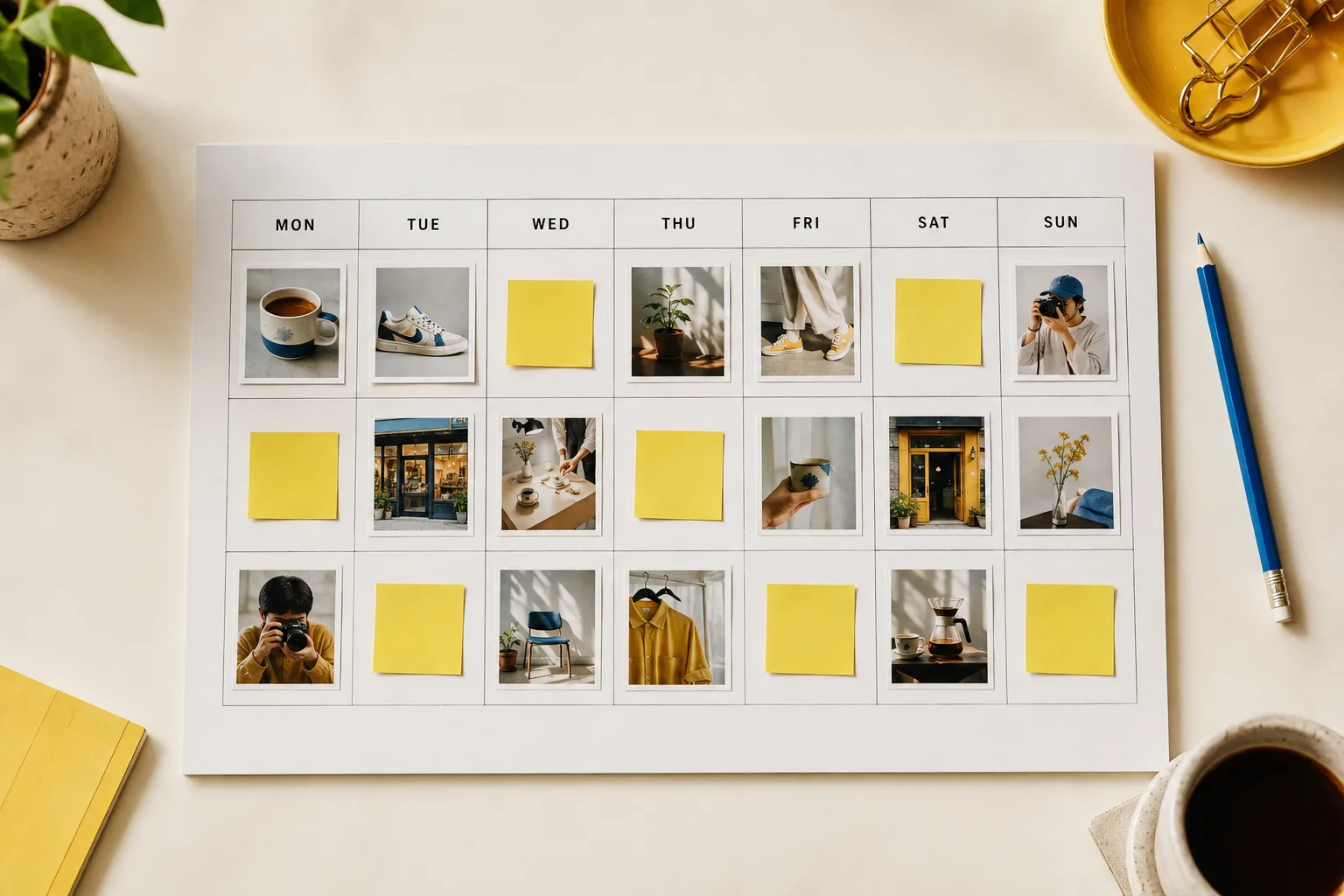
Map a six-post launch
Use the problem post to introduce the situation, the reveal to name the product, and the demonstration to show evidence. Follow with fit, practical details, and questions. Write the purpose of each in one sentence. If two posts do the same job, combine them and spend the time improving the demonstration.
Common questions
How should I adapt these examples?
Keep the structure, then replace the fictional details with your own audience, accurate offer, and real next step. The image and destination should tell the same story.
How do I decide whether the content worked?
Choose the intended action before publishing, then review relevant responses and downstream behavior. Views alone do not establish that a business goal was achieved.
Turn the brief into your own creative
Use the reusable brief with your actual product or service to develop an original creative concept.
Your starter brief
Replace the brackets with your own details.
Plan six launch posts for [product]: problem, reveal, demonstration, fit, practical details, and questions. Confirmed facts: [facts]. Availability: [status]. Include visual briefs, short captions, and a distinct next step for each. Label any concept imagery and avoid invented customer reactions.